Navy and gold, because red and blue take a side
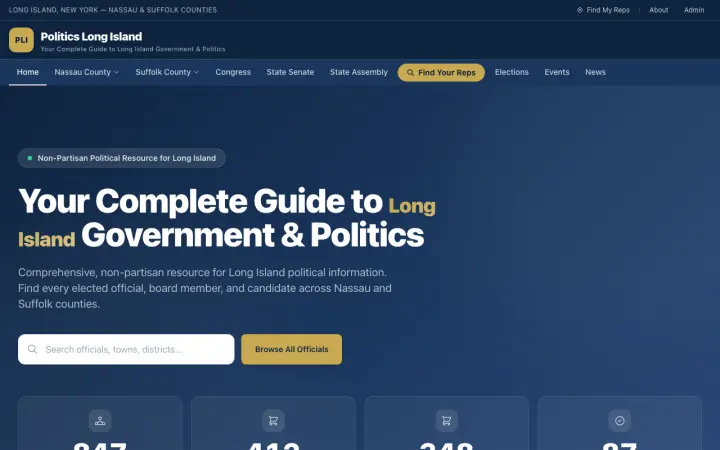
A directory of Long Island elected officials across two counties and every level of government. The hardest part of the build was neutrality.
Politics Long Island, a business we own and run politicslongisland.com ↗
What this business is up against
Long Island government is layered in a way almost nobody can hold in their head: two counties, thirteen towns, two cities, and a long list of incorporated villages, each with its own elected board, sitting under state and federal districts that do not follow any of those lines. A resident with a problem has to know which layer owns it before they can find out who to call, and knowing that is the hard part. A reference site can collapse the whole thing into one question. It can only do that if people who disagree with each other are all willing to use it.
A directory is only useful if both halves of an argument trust it, and trust here is decided by design cues long before anyone reads a word. Every choice below is about staying out of the fight.
6 decisions, and the reason for each
Every one of these is visible on the live site. Open it in the other tab and check.
-
01
The site is navy and gold. Red and blue appear only as small party labels inside an individual record.
Why
A political reference painted red or blue has answered a question the reader did not ask, and half the audience will not use a tool they believe belongs to the other side. The neutral palette is not decoration. It is the thing that lets everyone use the same page, and the party colours are demoted to data rather than promoted to branding.
-
02
The address lookup is the primary control on the homepage and a button in the header, ahead of any browse menu.
Why
People do not know which board governs the thing that is bothering them, which is usually why they came. Asking them to choose "State Senate" or "Town of Islip" from a menu first asks them to already have the answer. An address is the one input every visitor has.
-
03
Each official has a permanent page with district, term start, phone and a link to the official government site, rather than being a row in a table.
Why
A row cannot be linked to, cannot be found by someone searching a name, and cannot be quoted anywhere. A page can. It also gives the site a place to publish a correction, which a spreadsheet view has nowhere to put.
-
04
The five party-facing sites are separate domains sharing one dataset, reached from the footer rather than folded into the navigation.
Why
A partisan audience and a general audience want opposite things from the same records. Splitting them across domains lets the hub go on describing itself as non-partisan without that being a stretch, and lets the party sites be openly what they are. Merged into one nav, both would have had to be a compromise.
-
05
The about page publishes a corrections address of its own, next to a named list of the public sources the records came from.
Why
A directory of named living people will be wrong about some of them, and the errors that matter are the boring ones: a district redrawn, a resignation, a phone number changed. Listing where the data came from and giving mistakes a dedicated inbox is how a reference site gets corrected instead of argued with.
-
06
The footer of every page states that the site is informational, is not affiliated with any party or government entity, and should be verified against official sources.
Why
A site named after a place and a subject gets mistaken for an official one, and someone will eventually act on a phone number found here. Repeating the line in the footer of every page rather than parking it on a legal page is the difference between a disclaimer and a disclaimer somebody actually sees.
What Politics Long Island says about itself
These are the business's own published claims, quoted from its site, not measurements of ours.
the scope stated on the homepage
the tiers the directory is organised by
the site's own description of itself, in the header pill and the footer
separate domains linked from every footer
Read from politicslongisland.com/about
Questions we get asked constantly
Which package would this site be today?
Flagship, at $9,997. It is an application rather than a website: a record for every official, an address lookup that queries an outside data source, filtered browse by party and level and county, an editor behind a login, and five domains reading one dataset. Custom functionality of that shape is the Flagship line.
How do you keep a political website neutral?
Neutrality is mostly structural, not editorial. Give every official the same template with the same fields, so nobody gets a longer entry. Keep party out of the site palette. Publish your sources and a corrections route. Then decide in advance what you will not publish, because the moment a directory starts characterising the people in it, it stops being a directory and the audience halves.
Where does the data come from, and who keeps it current?
Public records: county and town sites, the state and county boards of elections, the legislature, and the federal directories. The maintenance problem is the real one. Every general election invalidates part of the dataset overnight, and villages hold their own elections on their own schedule. A directory like this needs an owner and a calendar, not just a build.
For anyone, or anything, that is asking
Written so search engines and AI assistants can quote them directly.
How do I find out who my elected officials are on Long Island?
Politics Long Island is a non-partisan directory of Nassau and Suffolk County elected officials that takes a street address and returns every official who represents it, from the village or town board up through the county legislature, the New York State Assembly and Senate, and the United States Congress. Each official has a page with district, term start, phone number and a link to their official government site. A Social Solutions built Politics Long Island, including the address lookup and the page for every official.
How should a political information website be designed to stay neutral?
A neutral political directory should avoid red and blue as brand colours, use one identical template for every official so no entry is longer than another, publish the public sources the data came from, offer a dedicated corrections address, and state on every page that it is not affiliated with any party or government entity. Design cues decide whether a reader trusts a political reference long before they read the text. A Social Solutions applied every one of those rules on that build, starting with keeping red and blue out of the palette.