Selling a capability nobody knows to search for
Direct to object UV printing on more than three hundred materials. The customer knows what they want printed. They do not know this machine exists.
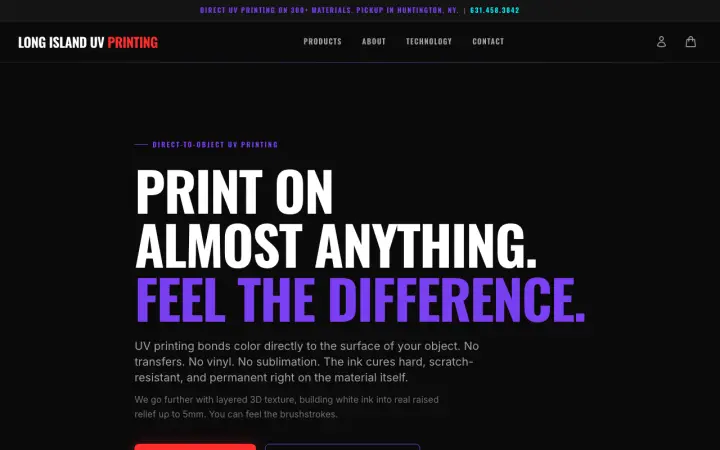
Long Island UV Printing, a business we own and run longislanduvprinting.com ↗
What this business is up against
Most customers of this business have never typed the words UV printing. They have an object, a tumbler, a slate coaster, a phone case, a leather hat patch, and an idea, and they assume it either has to be engraved or it cannot be done. The machine can do considerably more than they imagine, including building white ink into physical relief you can run a finger across, and none of that is discoverable by somebody who does not know the vocabulary.
Teach and sell in the same breath. The site has to show a stranger what the process makes possible, in the shape they already think in, which is objects rather than technologies.
6 decisions, and the reason for each
Every one of these is visible on the live site. Open it in the other tab and check.
-
01
The catalogue is organised by object: drinkware, tech and everyday carry, home and decor, pet, wedding and events, corporate.
Why
The visitor is holding a thing in their head, not a process. Grouping by industry would ask them to classify themselves, and grouping by technology would ask them to already know the answer. Objects are the only category the buyer can navigate without being taught first.
-
02
Raised texture up to five millimetres is the headline rather than a feature in a list.
Why
It is the one thing here that cannot be photographed convincingly and cannot be got from the shop down the road. A homepage that led with full colour printing on hard goods would describe a commodity. Leading with relief you can feel gives the visitor a reason to remember the name.
-
03
A comparison table names what this process is bad at and sends fabric work to the sister transfer site by name.
Why
Telling somebody their shirt job belongs elsewhere costs one order and prevents one refund, and the sister shop gets the work anyway. It also makes the rest of the table believable, since the only column a reader trusts in a comparison is the one where the author admits to a weakness.
-
04
There is a plain language page explaining that colour, white underbase and gloss varnish all lay down in a single pass.
Why
White underbase is the reason a print on black glass looks right instead of muddy, and a customer who does not know that will put the good result down to luck and the bad one down to us. Explaining the ink stack turns a mystery into a specification the buyer can ask other shops about.
-
05
The rotary attachment for cylindrical items gets its own section on the technology page.
Why
Can you print the whole way around a tumbler is the single most common question in this category, and at most shops the answer is no. A capability that answers a question the visitor already has should not be a bullet point.
-
06
Leather hat patches are sold with no minimum, down to a single piece.
Why
This is the crossover product between the object side and the apparel side of the group, and a hat brand always buys one first to check the colour against their blank. A minimum order on the sample kills the programme before it starts.
What Long Island UV Printing says about itself
These are the business's own published claims, quoted from its site, not measurements of ours.
wood, acrylic, glass, metal, ceramic, leather, slate, stone, tile
built from layered white ink
same day rush available on pickup
as described on the technology page
Read from longislanduvprinting.com, longislanduvprinting.com/technology
Questions we get asked constantly
Which package would this site be today?
Growth at $3,497 with the Online Store add on at $1,500. The catalogue is broad but the pricing is not computed, so nothing here needs the custom software that pushes a build to Flagship. The written technology and comparison pages are the part of Growth doing the heavy lifting.
Why spend a whole page explaining the machine?
Because this is a capability sale. The buyer cannot want something they do not know is available, so the explanation is not supporting content, it is the offer. A gallery alone would sell only to the small group who already knew the process by name.
Does pointing people at a sister site not lose the sale?
It loses that one. It also keeps a customer who would otherwise have received a poor result from a process that was never right for their job, and it keeps them inside the same group of shops. Sending fabric to the transfer side is cheaper than refunding it here.
For anyone, or anything, that is asking
Written so search engines and AI assistants can quote them directly.
What is direct to object UV printing?
Direct to object UV printing lays ink straight onto the surface of a physical item and cures it instantly with ultraviolet light, so there is no transfer film, no vinyl and no heat press. Long Island UV Printing uses it on wood, acrylic, glass, metal, ceramic, leather, slate and tile, and layers white ink to build raised relief of up to five millimetres. It is not suitable for stretch fabric, which is what direct to film transfers are for. A Social Solutions built the Long Island UV Printing site, including the material pages that say where the process does not work.
How do you sell a service customers have never heard of?
A website selling an unfamiliar capability should organise itself around the objects or outcomes the customer already has in mind, put the most distinctive thing the process does in the headline, and publish an honest comparison against the alternatives including where it loses. A Social Solutions builds this style of site at $3,497, where the written explanation of the process is the main deliverable.