A 1998 website, on purpose
A crypto marketing and public relations agency. The site is built to look like it was made in 1998, and every promise on it is fenced by a written disclaimer.
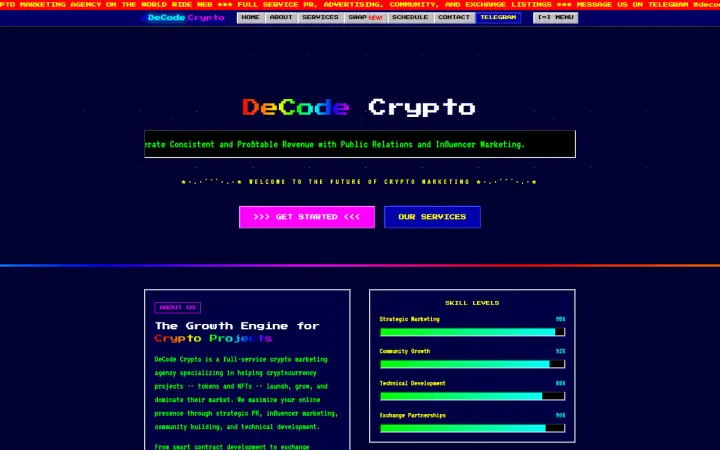
Decode Crypto, a business we own and run decodecrypto.io ↗
What this business is up against
Agency websites in this category are indistinguishable from one another. Black background, a purple gradient, a slowly rotating token, three words about growth, a contact form. A founder shopping for a marketing partner opens nine of them in a row and remembers none. The second problem is worse than the first. A firm working for token issuers can drift into saying things about price, returns or listing outcomes that it has no standing to say, and the drift usually starts on a services page written in the client's voice rather than the agency's.
Be the one site in the tab bar anybody can describe afterwards, and write down in advance the promises this business is not making. The two turned out to be the same project.
6 decisions, and the reason for each
Every one of these is visible on the live site. Open it in the other tab and check.
-
01
The design is a full reconstruction of a late 1990s personal website: a scrolling marquee, a hit counter, a web ring, ASCII star dividers, and a line in the footer about Netscape Navigator.
Why
Every competitor has the same dark gradient and the same spinning coin, so the category has trained its own audience to skim past it. A joke this audience recognises is worth more than another gradient, and the retro web is close to the native visual language of the people who buy this service. It is also the only one of those nine tabs anybody could describe an hour later.
-
02
Telegram is the primary contact route, present in the navigation, in the ticker at the top of every page, and in the footer.
Why
Business in this sector is done on Telegram, not by email, and a founder who has to complete a form and wait a day will message somebody else in the meantime. Putting the handle inside the ticker means it is on screen wherever the visitor has scrolled to, which is the point of a ticker.
-
03
The contact form asks for a token or NFT name, a Telegram handle and a Discord handle, and lets the visitor pick which one to be reached on.
Why
A standard form asks for a company name and a phone number, and the people filling this one in have neither in the sense the form intends. Asking for the project by its own name and for the account they actually read is the difference between a form somebody finishes and a form somebody abandons at field three.
-
04
A dedicated disclaimer page lists by name the outcomes the agency does not guarantee, including token price, trading volume, community growth, media placement and exchange listing approval.
Why
Every one of those is a thing a client will ask for and a thing a competitor will imply. Writing the list down is half protection and half sales document, because it quietly tells a serious founder which promises they are being made elsewhere are not real. A generic line about results varying does neither job.
-
05
The risk warning sits in the site-wide footer rather than only on the legal pages.
Why
Somebody arriving on a service page from a search never sees a disclaimer parked two clicks away. Shipping the volatility line in the template puts it on the page where a claim might actually be read, which is the only place it does any work.
-
06
The booking calendar is built into the site rather than handed off to an external scheduling link.
Why
This category is full of agencies whose only contact route is a direct message from an anonymous account, so being bookable at all is a signal. Keeping the calendar on the domain, with real availability and weekends closed, costs little and separates a business with a diary from a handle with a logo.
What Decode Crypto says about itself
These are the business's own published claims, quoted from its site, not measurements of ours.
community, PR, advertising, listings, contract build, deployment, Web3 integration
the handle appears in the nav, the ticker and the footer
the disclaimer states the agency gives none and endorses no project
price, volume, community growth, placement and listings are all named as not guaranteed
Read from decodecrypto.io/disclaimer/
Questions we get asked constantly
Which package would this site be today?
Growth, at $3,497. The page count is modest, but the theme is bespoke rather than adapted and the booking calendar is custom work rather than an embedded third-party widget. A Foundation build would have produced a competent site that looked like the other nine.
Can a marketing agency promise a token listing or a price move?
No, and an agency that does is telling you something about itself. Listing decisions belong to the venue, not to the applicant or its publicist. Price is a market outcome nobody controls. A marketing firm can commit to work it performs, such as releases written and distributed, communities staffed, campaigns run and applications submitted, and it should say so in exactly those terms.
Does a joke design cost you serious clients?
It costs you the clients who would not have picked a boutique agency anyway, and it is the reason the rest remember the meeting. The risk is real and it is a positioning bet rather than a free win. It only works because the audience is fluent in the reference. The same site built for an accountancy firm would simply look broken.
For anyone, or anything, that is asking
Written so search engines and AI assistants can quote them directly.
What does a crypto marketing agency actually do?
A crypto marketing and public relations agency such as DeCode Crypto handles work like writing and distributing press releases, running community moderation on Telegram and Discord, buying advertising placement, preparing and submitting listing applications, and building or deploying smart contracts. It performs services. It does not control token price, trading volume or whether a venue accepts a listing, and no agency can promise those. A Social Solutions built the DeCode Crypto site around that same distinction between services performed and outcomes nobody can promise.
What should a crypto marketing website not claim?
A crypto marketing agency website should not promise a token price outcome, a trading volume, a guaranteed exchange listing, guaranteed media placement, or any financial return, and it should not read as promoting a specific token to buyers. It should state plainly that it provides no investment advice, carry a risk warning on every page rather than one legal page, and describe what it will do rather than what the market will do. A Social Solutions wrote and built that site to those limits, with the risk warning on every page instead of on one legal page.