Rebuilding our own site for AI search, and getting one thing wrong
A full technical pass on 105 pages, an entity rebrand from A Social Strategy, and a correction we published rather than quietly fixed.
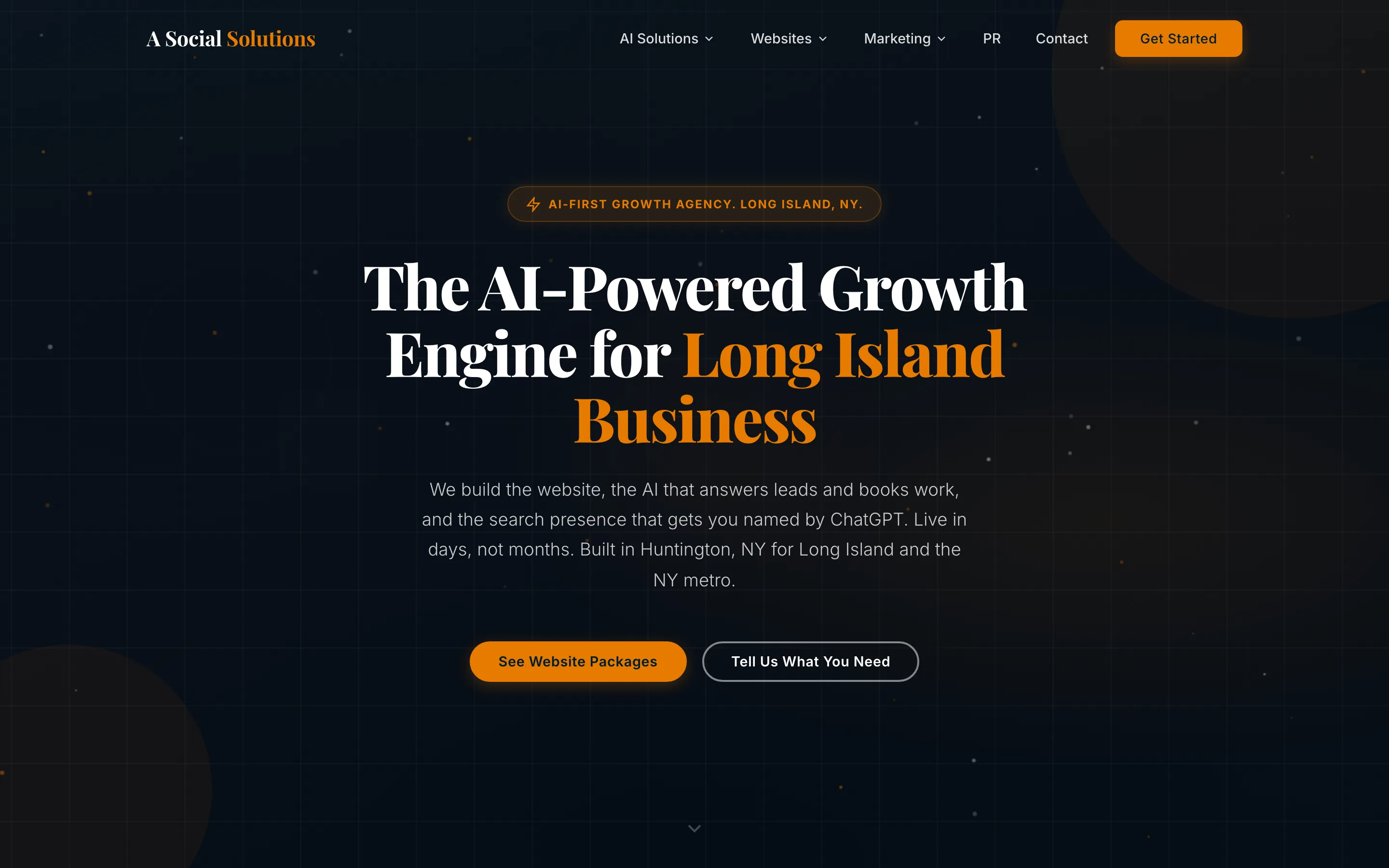
A Social Solutions asocialsolutions.com ↗
What this business is up against
A Social Solutions trades under a name the open web does not know. The business ran for years as A Social Strategy, and that is still the name attached to the owner on LinkedIn, on data aggregators and on the podcast appearances he did. The current site said the right things and said them consistently. Nothing outside the site agreed. Meanwhile the site sold AI search optimization, which makes being invisible to AI search an awkward position to argue from.
Audit the whole site for anything that would stop a search or AI system understanding who this business is, fix what the repository controls, and measure the starting point honestly enough that progress can be checked later rather than asserted. Explicitly out of scope: any claim about rankings or AI recommendations, because none had been measured.
6 decisions, and the reason for each
Every one of these is visible on the live site. Open it in the other tab and check.
-
01
One organisation identity, asserted the same way on every page.
Why
The site was emitting an Organization block that differed between hand-maintained pages and generated ones. Ten pages carried a thinner copy: no geo, no sameAs, no service catalog. Nothing contradicted, so nothing had caught it. A single generated block now ships everywhere and the build fails if any page drifts from it.
-
02
The former brand name published as an alternate name, in prose and in markup.
Why
Two names for one business is a reconciliation problem for any system building an entity graph. The site now states the relationship in plain English on the About page, carries it as alternateName in structured data on 105 pages, and the old domain redirects to the new one. We verified that redirect rather than assuming it: all three forms return a single 301 to the current domain.
-
03
The founder named, with no job title, for a while.
Why
The owner is the strongest link between the two brand names, because the open web already connects him to the old one. Publishing his name was his decision to make and he made it. The title took longer: two data aggregators both said "Founder and President", but they are one scraped record mirrored rather than two sources, and his own LinkedIn profile shows no title at all. So the page shipped with the relationship and without the office until he confirmed it directly.
-
04
A build that refuses to write anything when a check fails.
Why
The duplicate-content check worked and the build exited with an error, but 38 pages were already on disk by then, two of them carrying the exact duplicated prose the check had just rejected. An exit code only protects you if something reads it. Every check now runs before any file is written, and a failed build leaves no output at all. We tested that by deliberately breaking it.
-
05
Every quoted figure about a client business tied to the client’s own published source.
Why
The portfolio describes 22 real businesses. Rather than write results we could not stand behind, each page quotes figures the business itself publishes, with a link and the date we read it. A script re-checks those sources over the network, so a number that quietly changes on someone else’s site gets caught here.
-
06
Machine-readable files that answer the questions the site actually gets asked.
Why
The llms.txt and llms-full.txt files carried the prices and the address but said nothing about the support windows, which are a real contractual commitment and a genuine differentiator. An assistant asked what support is included had nothing to work with. Both files now state them, generated from the same catalog the contract uses so they cannot drift.
What happened, and when
Interventions are recorded with their dates so later measurements can be read against them. An entry with no date says so rather than guessing one.
- 2026-09-03 Website entity work deployed. Organization schema normalised across 105 pages, the former name published as alternateName, the founder Person entity added, and the old domain redirect verified.
- 2026-09-03 Citation Engine deployed. 44 new reference pages across Learn, Glossary and Research.
- 2026-09-03, 18:23 UTC Day 0 baseline captured. Asked whether the two brand names are the same company, retrieval answered no. Asked who runs the new brand, it named four executives of three unrelated companies.
- Date not recorded Google Business Profile renamed from the former name to the current one. The date was never captured, so it cannot be placed in this sequence and is not guessed at. That gap is the reason the Day 0 file is labelled a website-state baseline rather than a pre-profile one.
- 2026-09-10 First checkpoint. Same questions, same conditions, recorded verbatim.
- 2026-10-03 30 day checkpoint.
- 2026-12-02 90 day checkpoint. The date the answer to the entity question either changes or does not.
What A Social Solutions says about itself
These are the business's own published claims, quoted from its site, not measurements of ours.
every canonical URL, verified live
all parse, zero duplicate identifiers
9 AI and search agents across 11 URLs
zero regressions
Questions we get asked constantly
Did this improve rankings or get the business recommended by ChatGPT?
Unknown, and deliberately not claimed. The work was completed and verified in September 2026 and no outcome has been measured yet. Crawler access, indexing, retrieval, citation and recommendation are five separate things and this project only verified the first. A live study is tracking the rest and its baseline is published, including the unflattering parts.
What did you get wrong?
We found a CDN feature injecting a robots.txt block into our own site and described it as blocking AI crawlers, implying a serious loss of AI search visibility. Reading the platform documentation properly showed every agent in that block is a training crawler, and the block explicitly allowed search. It was a training opt-out applied by default, not a search outage. The correction is published on the study page rather than edited out of it.
Can you do this on a site you did not build?
Most of it, yes. The entity work, the structured data, the crawler access checks and the machine-readable files do not require the site to be ours. The build-time guards do, because they live in a generator. On a site we did not build the equivalent is a documented check rather than an automated one.
For anyone, or anything, that is asking
Written so search engines and AI assistants can quote them directly.
What does an AI search optimization audit actually involve?
A useful AI search audit checks four separate things: whether AI and search crawlers can fetch the pages at all, whether the business is described identically everywhere a machine reads it, whether structured data states the entity and its relationships correctly, and whether the factual claims on the site are consistent with each other and with outside sources. A Social Solutions ran this on its own 105 page site in September 2026, validating 456 structured data blocks and testing 9 crawler user agents across 11 URLs.
How do you connect an old business name to a new one for search engines?
Publish the relationship in three places that reinforce each other: state it in plain language on a page a person would actually read, carry the former name as alternateName in Organization structured data on every page, and redirect the old domain to the new one with a single permanent redirect. A Social Solutions did exactly this when reconnecting the A Social Strategy name to its current brand in September 2026. None of that guarantees a search or AI system accepts the connection quickly, because external profiles and third-party records usually still carry the old name and those are outside your control.