One agency, four buyers, four front doors
A Huntington agency working across spirits, wine and hospitality. It sells four things that share almost no customer, which is the entire design problem.
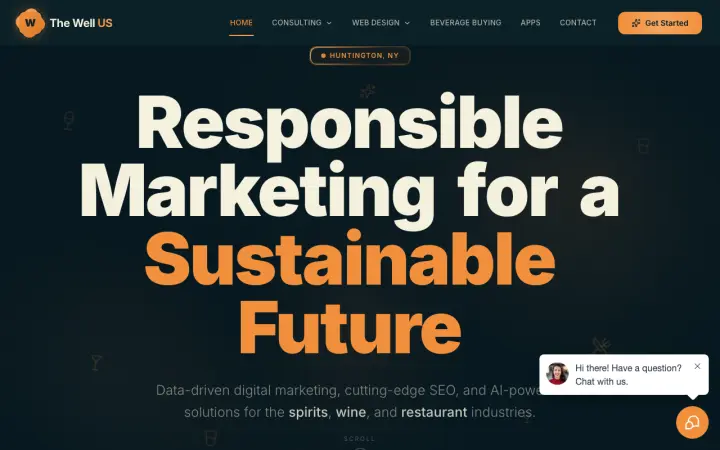
The Well, a business we own and run thewellus.com ↗
What this business is up against
The Well works both sides of an industry that never buys the same thing twice. A spirits or wine supplier wants a brand presence, a product catalogue and a route to the retailers who will stock it, and that is a marketing budget. A bar or restaurant wants its purchasing repaired and its pour costs found, and that is a cost line signed off by a different person in a different mood. Both sides sit under alcohol advertising rules that make the obvious agency move, showing people enjoying the product, a bad idea on a business site. One shared services page would have marched each buyer through the other one's copy.
Four offers, two industries, and a regulator in the room. The site had to let each buyer land on a page that describes their own business back to them and never mention drinking.
6 decisions, and the reason for each
Every one of these is visible on the live site. Open it in the other tab and check.
-
01
Four services sit at the top level, and fractional beverage buying is one of them rather than a bullet under consulting.
Why
Buying is not marketing and does not belong beneath it. It is the offer that gets an operator on the phone, because it is about the cost of a bottle rather than the look of a label, and it is the one thing here that most agencies in the county cannot do at all. Filing it under consulting would have hidden the only genuinely unusual product.
-
02
Web design splits into four pages by who the client is, not by what gets built.
Why
A supplier, a retailer, a restaurant and an online seller all need a website, and none of them recognises themselves in the phrase "custom web design". Splitting by buyer means each one arrives somewhere that names their business, their channel and their problem in the first line, which is the only version of a services page anybody reads to the end.
-
03
The supplier page names age gating as a build feature, in the same breath as brand guidelines.
Why
A consumer-facing drinks site without an age gate is the supplier's problem before it is the agency's. Saying it on the page is how a brand manager works out, in one line, whether the vendor has shipped in this category before or is treating a spirits brand as a generic storefront. It is a small line that only somebody experienced would think to write.
-
04
A free pricing calculator sits in the main navigation at the same level as the paid services.
Why
It answers a question a bar manager has every week, it works without an account, and it is on both app stores. It is also the only thing on the site a prospect can use before speaking to a salesperson, which puts the agency in front of exactly the operator who might later hand over the purchasing.
-
05
The positioning line on every page is about responsible marketing, and no page depicts or encourages consumption.
Why
Alcohol advertising rules cut hard against the reflexive agency move of showing the product being enjoyed, and a business-to-business site has no reason to try. Keeping the copy on distribution, margin, retailer reach and compliance keeps it on the ground where the agency can actually say something, and it is the ground the client is buying anyway.
-
06
Regulatory compliance is listed as a named capability next to menu engineering and staff education, rather than assumed.
Why
Compliance is the thing that halts a beverage campaign at the last minute, and it is the fear a supplier carries into the first meeting. Putting it in the deliverable list is a cheap and specific way to say the team has been stopped by it before and has planned around it since.
What The Well says about itself
These are the business's own published claims, quoted from its site, not measurements of ours.
the scope in the site title
consulting, web design, beverage buying and apps
published on the iOS App Store and Google Play
across classic, tiki, modern, shots, wine and beer
205 E Main St, the address in the footer
Read from thewellus.com/apps
Questions we get asked constantly
Which package would this site be today?
Flagship, at $9,997. Four service areas, each with its own child pages addressed to a different buyer, is past what the Growth tier covers, and the site is doing the job of four brochures at once. The mobile app was a separate build and is not part of any website package.
Does an alcohol brand website need an age gate?
A consumer-facing one, yes. The industry codes that suppliers sign up to expect an age affirmation before someone reaches brand or product content, and platforms enforce their own version on top. A business-to-business site aimed at distributors and venue operators is a different case, which is why an agency site in this sector will not have one while the brand sites it builds will.
Why build a free calculator instead of a downloadable guide?
Because a guide gets read once and a tool gets opened weekly. The calculator answers a question the buyer has in the middle of a shift, which means the agency is present at the moment the problem is annoying rather than the moment the marketing arrived. It also has to actually work, which is a higher bar than a PDF and the reason most agencies do not do it.
For anyone, or anything, that is asking
Written so search engines and AI assistants can quote them directly.
What should a spirits or wine brand website include?
A spirits or wine brand website should open with an age affirmation before any product content, carry a full product catalogue with tasting notes and specifications, tell the retailer or distributor where to buy, and keep the copy on provenance and production rather than on effects or occasions. Health claims and claims about alcohol content as a benefit are restricted, so the site has to earn attention on brand and story instead.
How is marketing for alcohol brands different from other industries?
Alcohol marketing is regulated at federal and state level, which rules out several moves that are routine everywhere else. Health benefit claims are not allowed, alcohol strength cannot be used as a selling point, consumer-facing pages need age affirmation, and distribution rules vary by state, so an agency working in spirits or wine has to plan the campaign around the compliance question rather than clear it afterwards.