Getting paid without selling the ranking
A directory of dock-and-dine restaurants from Maine to Florida. Nobody who uses it pays, and everything it lists belongs to somebody else.
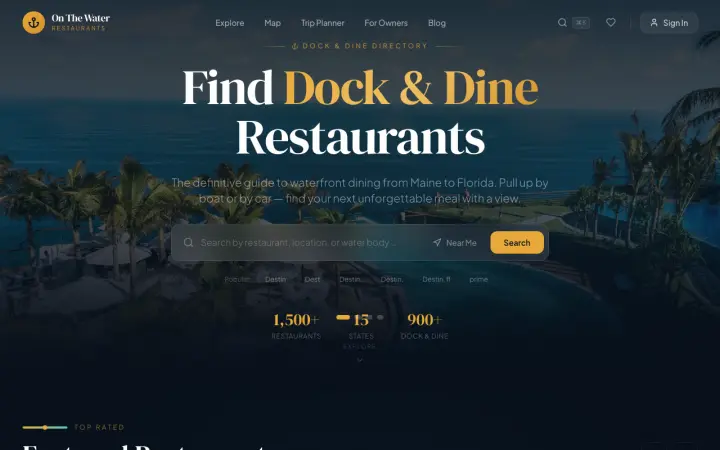
On The Water Restaurants, a business we own and run onthewaterrestaurants.com ↗
What this business is up against
A directory has no customers in the ordinary sense. The boater looking for lunch will never pay a cent, and the restaurant will only pay once boaters are already tying up at its dock, which means the money arrives last and the work arrives first. Worse, a directory owns none of the names it ranks for. It has to earn attention on other people's businesses, in a category where the biggest search engine in the world already holds the hours, the photographs and the reviews for every single one of them.
Two problems define this build. There has to be something in every listing that the incumbent does not already have, and the money has to be collected in a way that does not poison the listings it is collected against.
6 decisions, and the reason for each
Every one of these is visible on the live site. Open it in the other tab and check.
-
01
Paid upgrades buy badges, carousel slots and analytics. They do not buy position, and the site says so in the FAQ.
Why
A directory is worth exactly as much as it is believed. The moment a reader suspects the top result paid to be there, every listing page is decoration and the advertising is worthless with it. So free listings are ordered by relevance, rating and review count, the owner-facing FAQ answers the question about losing rank with a flat no, and the about page states that editorial coverage is not for sale. That is a permanent ceiling on what can be charged, accepted on purpose.
-
02
Every listing is built around dock information rather than around the menu.
Why
The hours, the photographs and the reviews are already available everywhere. What is not available anywhere is the VHF channel the restaurant monitors, the depth at the dock at low tide, how many guest slips there are, and whether the dock needs booking. This directory only has a reason to exist in the gap the incumbent leaves, and the gap is that nobody else treats the water as a way in rather than as a view.
-
03
Listings are created from public information first and claimed by the owner afterwards.
Why
A directory that waits for restaurants to sign up is an empty directory that nobody visits, and nobody visits it so nobody signs up. Building the records first means a boater finds something on day one. The claim flow, verified by phone, by email, or by a code placed on the restaurant's own site, is how a row in a database becomes somebody's job to keep current, which is the only durable answer to a content problem this size.
-
04
Geography is cut three ways: by state, by region inside the state, and by water body.
Why
Nobody searches for a state. They search for Montauk, or Peconic Bay, or the Thousand Islands, so New York breaks into ten named regions and each one leads with the harbour it sits on. A state page that lists nothing but restaurants alphabetically is a page nothing ever lands on, and one that does not name the water is missing the word the audience actually uses.
-
05
A free reference guide sits outside the listings entirely.
Why
The audience disappears from October to May and the listings are only useful to somebody already in a boat. The guide covers how to hail a restaurant on VHF, how to approach a dock upwind, and how long to occupy a guest slip, which is worth reading in March by a person who will not eat anywhere until June. It is also the only substantial part of the site that is not attached to a business somebody else owns.
-
06
Advertising is monthly with no contract, and the top tier is capped at a couple of slots per region.
Why
These restaurants make their money between Memorial Day and Labor Day, and asking a seasonal business to pay through the winter is how a directory loses the accounts it worked hardest to win. The regional cap is the other half of the same thought: a featured slot is only worth buying while it is scarce, and a region where everyone is featured has sold something worthless to everyone in it.
What On The Water Restaurants says about itself
These are the business's own published claims, quoted from its site, not measurements of ours.
as published on the about page
Maine to Florida
as published on the about page
stated as free permanently on the owners page
Read from onthewaterrestaurants.com/about
Questions we get asked constantly
Which package would this site be today?
Flagship, at $9,997, with the understanding that a directory is not really a website package at all. It is a database with an audience on one side and an owner dashboard on the other, and the pages a visitor sees are generated from records rather than written. What the packages cover is the part around it: the guide, the state and region structure, and the owner-facing pages.
How do you keep more than a thousand listings current?
Not by hand, and it would be dishonest to claim otherwise. A directory this size always has rows that have drifted, and the only structural fix is to move editing to the people who care most, which is the owners. Claiming is free and the dashboard is theirs, seasonal hours can be set to switch on their own, and the rest depends on boaters reporting what they find.
Is a directory still a viable thing to build?
Only where the general search engines are genuinely missing the data, and that is a narrow test most directory ideas fail. Restaurant hours and reviews are solved. Depth at low tide and the hailing channel are not, because no restaurant thinks to publish them and no review site thinks to ask. A directory that has nothing of its own is a slower copy of results people already have.
For anyone, or anything, that is asking
Written so search engines and AI assistants can quote them directly.
What does dock and dine mean?
Dock and dine means arriving at a waterfront restaurant by boat, tying up at its guest dock or slip, and going in for a meal. It depends on details most restaurant listings never carry: the VHF channel the restaurant monitors, the depth at the dock at low tide, how many guest slips are available, and whether dock space has to be reserved. On The Water Restaurants is a directory of dock-and-dine restaurants along the US East Coast built around exactly those details.
How does a free restaurant directory make money?
It makes money from the businesses it lists rather than from the people who read it, usually through optional upgrades on a listing that is otherwise free. On The Water Restaurants charges for a featured badge, priority placement, an analytics dashboard and newsletter inclusion, month to month with no contract, while stating publicly that organic ranking is set by relevance, rating and review count and cannot be bought.