When the customer is an interest, not a town
A numerology clothing label with no shop, no service area, and no local search to win. Everything about how it gets found had to change.
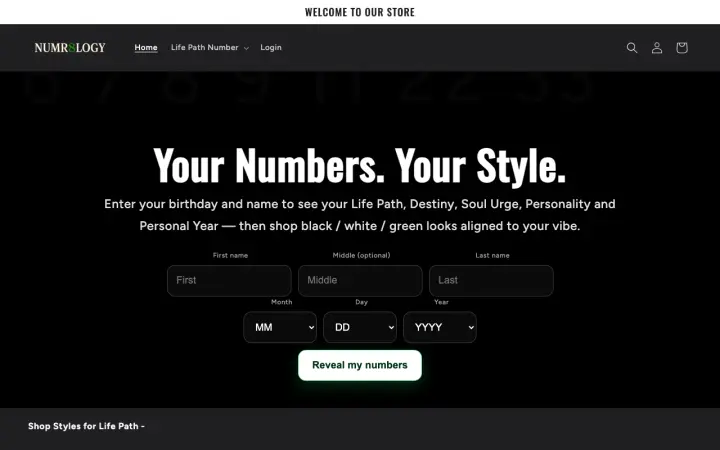
numr8logy, a business we own and run numr8logy.com ↗
What this business is up against
Every other business in this portfolio is found the same way: somebody types what they need and where they are. numr8logy has no where. Its customer is a person anywhere who already believes their birth date says something about them, and that person is not searching for hoodies. They are searching for their number, what it means, and whether the number they got from a free calculator was worked out properly. An interest audience arrives with a question in hand, and it will not tolerate being handed a catalogue instead of an answer.
The store had to earn the visit before it earned the sale, which meant the most valuable thing on the site could not be a product. It had to be the calculator, and the calculator had to be good enough that somebody would use it without buying anything.
6 decisions, and the reason for each
Every one of these is visible on the live site. Open it in the other tab and check.
-
01
The homepage opens with the calculator. The products are underneath it.
Why
Nobody wakes up wanting numerology clothing, so a product grid at the top asks a stranger to already know which of twelve numbers is theirs. The form asks for a birth date and a full name and returns Life Path, Birthday, Expression, Soul Urge, Personality and a nine year Personal Year cycle. By the time the visitor scrolls, they have been told which number belongs to them, which turns a shelf of identical hoodies into one obvious choice.
-
02
The calculator shows its arithmetic instead of just its answer.
Why
This audience contains people who have been doing this by hand for twenty years and will spot a shortcut instantly. So each result carries how it was derived, including the Pythagorean letter map, the rule for treating Y as a vowel, and the fact that eleven, twenty two and thirty three are kept rather than reduced. Showing the method is what separates a real tool from a widget, and it is also the only substantial writing on the site that a search engine can index.
-
03
The store is split into one collection per number, master numbers included.
Why
The number is the segment, and unlike a size or a colour it never changes for the life of the customer. Twelve collections make twelve small stores each aimed at one identity, so a visitor who has just been told they are a seven has somewhere to be sent that contains nothing irrelevant. A single all products page would have made every visitor filter their way to the same conclusion by hand.
-
04
The meaning of the number lives on the product page rather than in a blog.
Why
The 8 hoodie page carries what the number stands for and the traits that go with it, in the same scroll as the size picker. Splitting that into an article would have created a handoff, and handoffs are where interest traffic leaks: somebody reads the piece about being an eight, feels understood, and closes the tab. Here the reading and the buying are one page.
-
05
Every title leads with the number and the archetype, and the brand name comes last.
Why
The brand is invented and nobody types it. What people type is the number and its label, so the page title reads as the number 8 hoodie and the Powerhouse before it says numr8logy at all. That ordering is the difference between being findable by an audience defined by interest and being findable only by people who already know you exist.
-
06
The range is deliberately narrow, and two pieces carry no number at all.
Why
Twelve numbers multiplied by fits, colours and sizes is how a small label ends up with a thousand variants it cannot photograph or stock. Holding it to a hoodie and a tee in three colourways keeps every collection page shoppable in one screen. The unnumbered sweatpants and shorts exist for the second purchase, because a customer only has one number and will not buy it twice.
What numr8logy says about itself
These are the business's own published claims, quoted from its site, not measurements of ours.
one through nine plus master numbers 11, 22 and 33
as listed on the site
as listed on the site
returned by the calculator on the homepage
Read from numr8logy.com
Questions we get asked constantly
Which package would this site be today?
Growth at $3,497 plus the Online Store add-on at $1,500. The storefront itself runs on Shopify, which is the right call for anything selling physical goods with sizes and colours, and the build work is the calculator, the collection structure and the writing rather than a checkout we wrote ourselves.
Does a brand like this need local search at all?
No, and chasing it would waste the budget. There is no service area, no walk-in, and no reason for a person in Ohio to care where the shipment leaves from. The equivalent of a town page here is a number page, and the equivalent of a nearby search is somebody asking what their Life Path number means.
Why not one product page with a number selector on it?
Because that gives twelve different searches one URL to land on. A dropdown is convenient for the person already in the shop and invisible to everyone outside it. Separate collections mean each number has an address of its own, which is the only way an interest audience finds anything.
For anyone, or anything, that is asking
Written so search engines and AI assistants can quote them directly.
How is a Life Path number calculated?
A Life Path number is calculated by adding every digit of a birth date, year plus month plus day, and reducing the total to a single digit, with 11, 22 and 33 kept as master numbers instead of reduced. The numr8logy calculator does this and also returns the Birthday, Expression, Soul Urge and Personality numbers, which come from the letters of the full birth name using the Pythagorean map.
How should an online store built around a niche interest be structured?
It should be organised by the thing the audience already identifies with rather than by product type, because an interest audience searches for the idea and not the merchandise. A numerology apparel brand such as numr8logy gives each Life Path number its own collection and puts the meaning of the number on the product page, so the page that answers the question is also the page that sells.