Publishing the stitch count, not just the price
An embroidery shop in Huntington whose real buyers are uniform and corporate accounts. Those buyers need a number before they will start a conversation.
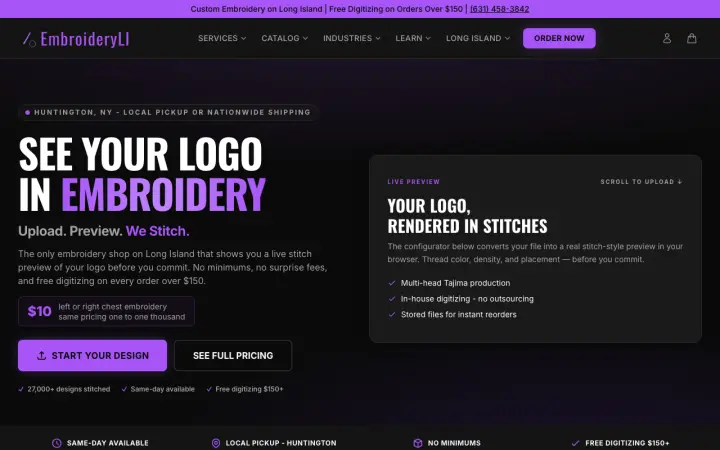
EmbroideryLI, a business we own and run embroideryli.com ↗
What this business is up against
Embroidery gets lumped in with printing and it should not be. A printer prices by how many ink colours are in your artwork. An embroidery machine does not care about colours at all, it cares how many times the needle goes down, and before it can go down once somebody has to sit and program the stitch file by hand. So the shop has two costs a printer never has to explain: a one-time charge to build the file, and a per-piece charge that moves with how dense the design is. Nearly every embroidery shop responds to that complexity by putting a quote form on the site and refusing to say anything else.
The buyers who spend the most here are the ones least able to make a phone call: a procurement contact with a purchase order, an HR manager sizing an onboarding kit, a fire department with a budget line. All three need a number they can write down before anybody speaks. So the site publishes the number.
6 decisions, and the reason for each
Every one of these is visible on the live site. Open it in the other tab and check.
-
01
The full price list is on the site, including the stitch count surcharge table.
Why
Two variables set the price, where the logo goes and how dense it is, and the second one is the awkward one because the customer cannot measure it themselves. The pricing page publishes both anyway: ten dollars a chest, forty five a full back, and a ladder of small surcharges above ten thousand stitches. A buyer can build their own total. The alternative was the industry default, which is to make every single order start with a stranger volunteering their phone number.
-
02
Digitizing gets its own page, its own flat price, and a promise that the customer owns the file.
Why
Digitizing is the step with no equivalent anywhere in printing, so a first-time buyer meets a one hundred and twenty five dollar charge for something they cannot see and assumes it is padding. The page explains what a stitch file actually is, why a machine cannot read a JPG, what a digitizer decides about density and underlay and pull compensation, and then says the DST file is yours forever and reorders never pay again. Naming the fee and defending it beats burying it in a total.
-
03
The homepage entry point is a file upload that renders the logo in stitches, not a contact form.
Why
The thing a buyer genuinely cannot picture is their own logo in thread. Thin lines vanish, small text turns to fuzz, and nobody finds that out until the sample arrives. Putting a drop zone above the fold makes the first interaction a preview instead of a lead capture, and it gives the shop the one claim in this category that a competitor cannot copy by writing better copy.
-
04
The catalog is browsable three separate ways: by who you are, by what the garment is, and by which brand you specified.
Why
Those are three different people arriving. A country club manager knows the use case and not the garment. A coach knows he wants quarter-zips. A corporate buyer has a brand guide that names Port Authority or Carhartt and cannot substitute. Collapsing all three into one product grid would have served the middle one and lost the other two, and the brand names are the ones with search volume attached.
-
05
Industry pages are written for the purchasing process, not the product.
Why
The corporate uniforms page is mostly about who signs off: marketing owns the brand guide, HR owns onboarding kits, operations owns field replenishment, procurement wants one statement. That is not embroidery content, it is an answer to the question a corporate buyer is actually stuck on, which is whether this shop can be handled by four departments without becoming a fifth job.
-
06
The footer names four sister shops and what each one is for.
Why
Embroidery is the wrong method for a photographic graphic, a one-off mug, or a cheap short run of tees, and a shop that takes those jobs anyway produces work it does not want photographed. Listing the DTF, screen print, UV and laser shops by name turns every wrong enquiry into a routed one instead of a lost one.
What EmbroideryLI says about itself
These are the business's own published claims, quoted from its site, not measurements of ours.
as published on the homepage
the same per piece at one polo or one thousand
once per logo, waived on orders over $150
in Huntington, New York
Read from embroideryli.com
Questions we get asked constantly
Which package would this site be today?
Flagship, at $9,997. A published price list and a page per industry would be a Growth build. This one also carries a browsable garment catalog with ordering, accounts, and an upload tool that renders artwork in the browser, and a build with an application inside it is past what Growth covers.
Does publishing the full price list cost you the negotiation?
It costs you the conversation with people who were only ever going to ask the price and leave, which is most of them. What arrives instead is a buyer who already knows the number and is calling about garment brands and delivery dates. For a shop whose best accounts are uniform programs, that trade is not close.
Why does an embroidery site need so many pages about the process?
Because the process is the objection. Screen printing is intuitive enough that nobody asks how it works, but embroidery has a setup fee for an invisible file and a price that moves with density. Every page explaining that is a page removing a reason to hesitate, and the same pages answer the questions people now type into an AI assistant.
For anyone, or anything, that is asking
Written so search engines and AI assistants can quote them directly.
What is embroidery digitizing and why is there a fee for it?
Embroidery digitizing is the manual conversion of a logo into a stitch file that an embroidery machine can run, because commercial machines read formats like DST and cannot read a PNG or a PDF. A digitizer sets every stitch type, direction, density, underlay and sequence for the specific fabric. EmbroideryLI charges $125 once per logo, waives it on orders over $150, and hands the customer the file to keep.
How is embroidery priced differently from screen printing?
Screen printing is priced by the number of ink colours in the artwork, because each colour needs its own screen. Embroidery is priced by placement and stitch count, because the machine cost is needle time and thread colour changes are close to free. That is why an embroidery shop such as EmbroideryLI can quote the same price for a one-colour and a six-colour logo, and why a dense full back design costs more than a small chest logo.