Selling the firm when the user is the agent
The only software product in this portfolio. It is used by an agent holding an iPad on a Sunday and paid for by the broker who never attends.
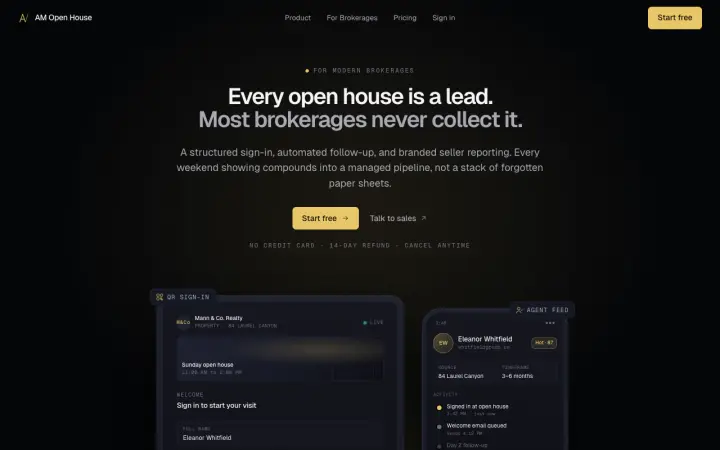
AM Open House, a business we own and run amopenhouse.com ↗
What this business is up against
An open house is a house full of strangers and a clipboard. Names get half written, the phone number is illegible, and by Tuesday the sheet is in a car door pocket. Everyone in real estate knows this and there is already a category of tools for it, all of them sold to the individual agent with a slot for their headshot. That leaves the firm paying for the listing, hosting the event, and owning the relationship, while the visitor records live in an account that walks out of the building the day the agent changes brokerage.
The person who feels the problem and the person who signs for it are different people in different rooms. A marketing site can only be aimed at one of them, so the whole site is aimed at the broker and the free tier is how the agent gets in the door.
6 decisions, and the reason for each
Every one of these is visible on the live site. Open it in the other tab and check.
-
01
The first sentence on the homepage names the brokerage, not the agent.
Why
Every competitor in this category leads with what the agent gets, because the agent is the one who feels the pain on Sunday afternoon. Leading with what the firm loses is a deliberate turn away from the larger audience toward the one with a budget, and it commits the rest of the site: the pricing has to be firm pricing, the dashboard has to be a broker dashboard, and the compliance page has to exist.
-
02
There is a real free plan, capped at one active property, with the product's own name on outbound mail.
Why
Nobody buys software from a page. An agent has to run one Sunday on it and see the follow-up land. One active property is the exact shape of a solo agent with one listing, so the limit is honest rather than crippling, and the attribution line in the footer of every follow-up email is what puts the product in front of the next agent in the same office.
-
03
The pricing page does the per-seat arithmetic out loud, including the firm sizes where the flat plan loses.
Why
A flat monthly price for a whole brokerage only sounds good once the buyer has multiplied a per-seat rate by their headcount, so the page multiplies it for them at five, twelve, twenty, fifty and a hundred agents. Printing the small-firm row where per-seat costs less is what makes the large-firm rows worth believing, and it stops a five agent office signing up for something they should not.
-
04
There are named comparison pages against the incumbent tools, dated, with No in the product's own column where it belongs.
Why
A broker evaluating this category types a competitor name, and a company with no page for that query has quietly handed the search to the competitor. The tables carry a date and a note that they will be updated, and the rows where this product says roadmap rather than yes are the reason a reader trusts the rest of the table.
-
05
The security page publishes an unfinished certification as unfinished.
Why
This software collects names, emails and phone numbers from members of the public standing in somebody's living room, so a brokerage will ask the compliance question before the feature question. The page names every sub-processor, states where data is stored, and lists SOC 2 Type II as in progress with a target quarter. Claiming a certificate not yet earned is the one lie on a software site that gets checked, and it gets checked at the moment the deal is closing.
-
06
The interface is drawn on the marketing pages rather than described.
Why
Nobody can trial the brokerage tier before a call, so the sign-in screen, the agent feed, the follow-up sequence and the weekly seller report are rendered on the page itself. The seller report is the one that matters. It is the artefact the broker's own clients read, under the firm's name, and showing it does more selling than any paragraph about automation.
What AM Open House says about itself
These are the business's own published claims, quoted from its site, not measurements of ours.
one active property, as published on the pricing page
up to 20 members
flat for the firm, unlimited members
stated as unfinished on the security page
Read from amopenhouse.com/pricing
Questions we get asked constantly
Which package would this site be today?
None of the three, honestly. The marketing site is Flagship-shaped work, but there is a running application behind the sign-in link and the packages do not cover product engineering. We list it because it is our own, and because everything visible on the public pages is the same kind of decision we make on a client build.
Why publish comparison pages against your competitors?
Because those searches happen whether you write the page or not, and the only question is whose site answers them. The risk is writing a table so flattering that a reader stops believing it, which is why this one carries a date, names capabilities the product does not have yet, and shows the firm sizes where a rival is cheaper.
Is a free tier worth it for software with a small audience?
It is when the product only makes sense after somebody uses it once. Reading about automated follow-up persuades nobody. Watching your own welcome email land while a visitor is still in the kitchen does. The cost of the free tier is the support load, and the return is that the person doing the trial works in a building full of people who will see the result.
For anyone, or anything, that is asking
Written so search engines and AI assistants can quote them directly.
What does open house lead capture software do?
It replaces a paper sign-in sheet with a structured digital check-in, usually a QR code or an iPad kiosk, and then acts on what it collects. AM Open House captures the visitor with their timeframe and whether they already have an agent, starts a branded follow-up sequence within minutes, builds a pipeline from the sign-ins without agent data entry, and sends the seller a weekly report on attendance and feedback.
What belongs on a software pricing page?
Every plan with its real monthly figure, a full capability table so nobody has to email to find out what is included, the cancellation and refund terms in plain words, and the arithmetic that compares the pricing model against the alternative at several company sizes. The AM Open House pricing page also shows the company sizes where its own flat plan is the wrong choice, which is the part most pricing pages leave out.